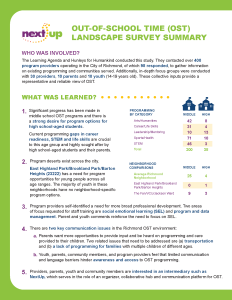
In 2024, Richmond nonprofit NextUp and research partner Hunleys for Humankind conducted a comprehensive OST landscape survey. Over 400 local providers were contacted; 98 responded, along with feedback from 30 providers, 10 parents, and 10 youth (aged 14–19). This report offers a rich snapshot of out‑of‑school time opportunities, program gaps, and community needs across Richmond.
Study Objectives and Methodology
Goal: Map existing OST programs and identify service deserts or equity barriers.
Approach:
- Survey of 98 OST program providers
- Focus groups with providers, parents, and youth
This robust mix ensures a representative overview grounded in community voices.
Major Findings
1. Growing Middle School Access — Gaps for Teens
Middle school offerings are gaining traction, but high school (14–19 years old) programs remain scarce.
High schoolers and their families highlighted a need for career readiness, STEM, and life-skills programming.
2. “Program Deserts” Across the City
Notably, ZIP code 23222 (East Highland Park/Brookland Park/Barton Heights) has minimal OST infrastructure across all age groups.
3. Urgent Demand for Professional Development
Providers expressed strong interest in training on social-emotional learning (SEL) and data/program management—echoed by parents and youth.
4. Communication and Access Barriers
Communication gaps: Families and providers want greater two‑way input in program planning.
Access issues: Transportation hurdles and limited age-inclusive programming hinder enrollment—especially for multi-age households and English Language Learners.
5. Support for an OST Intermediary
Participants across the board are interested in an OST intermediary like NextUp—coordinating efforts, increasing visibility, and improving communication across youth development organizations and providers.
Program Landscape in Numbers
Programming By Category
| Age Group | Arts/Humanities | STEM | Career/Life Skills | Sports/Health | Leadership/Mentoring |
|---|---|---|---|---|---|
| Middle School | 42 | 46 | 31 | 71 | 10 |
| High School | 8 | 3 | 4 | 10 | 13 |
What This Means for Richmond
- Teen-focused programming: There’s a strong appetite for OST offerings aligned with career exploration, STEM skills, and life preparedness.
- Targeted investment zones: Neighborhoods like 23222 should be prioritized in outreach and funding.
- Capacity building is key: Professional development for program staff—especially around SEL and data—is essential to enhance quality.
- Communication is central: Strengthening family-provider dialogue, improving transportation, and addressing language barriers are critical next steps.
- NextUp as a catalyst: Serving as a systems-builder, NextUp is uniquely positioned to drive collective impact through coordination, shared tools, and centralized communication.
Call to Collective Action
To address the landscape survey’s findings, the report recommends:
- Forming cross-sector partnerships — including government, businesses, and community groups — to increase access, transportation, volunteer support, and safe facilities.
- Investing in professional development — offering SEL, data management, and program design training to providers.
- Strengthening communication infrastructure — like OST marketing, youth/family input channels, language access, and an improved program locator tool.
- Driving equitable program expansion — focusing on teens and neighborhoods with few existing services.
How You Can Help
- Families and youth: Share your OST needs and ideas.
- Providers: Join NextUp’s network for training and capacity support.
- Funders and business partners: Invest in intermediary organizations like NextUp and equitable program growth.
- Community members: Advocate for transportation and safe OST spaces.
Conclusion
Richmond’s OST landscape shows promise, but critical gaps remain—especially for high-school-aged youth and in neighborhoods most impacted by crime and fincncial hardship. With targeted investment, collective coordination, and stronger communication, NextUp and its partners are building a foundation for inclusive, quality enrichment opportunities for every young person in Richmond.